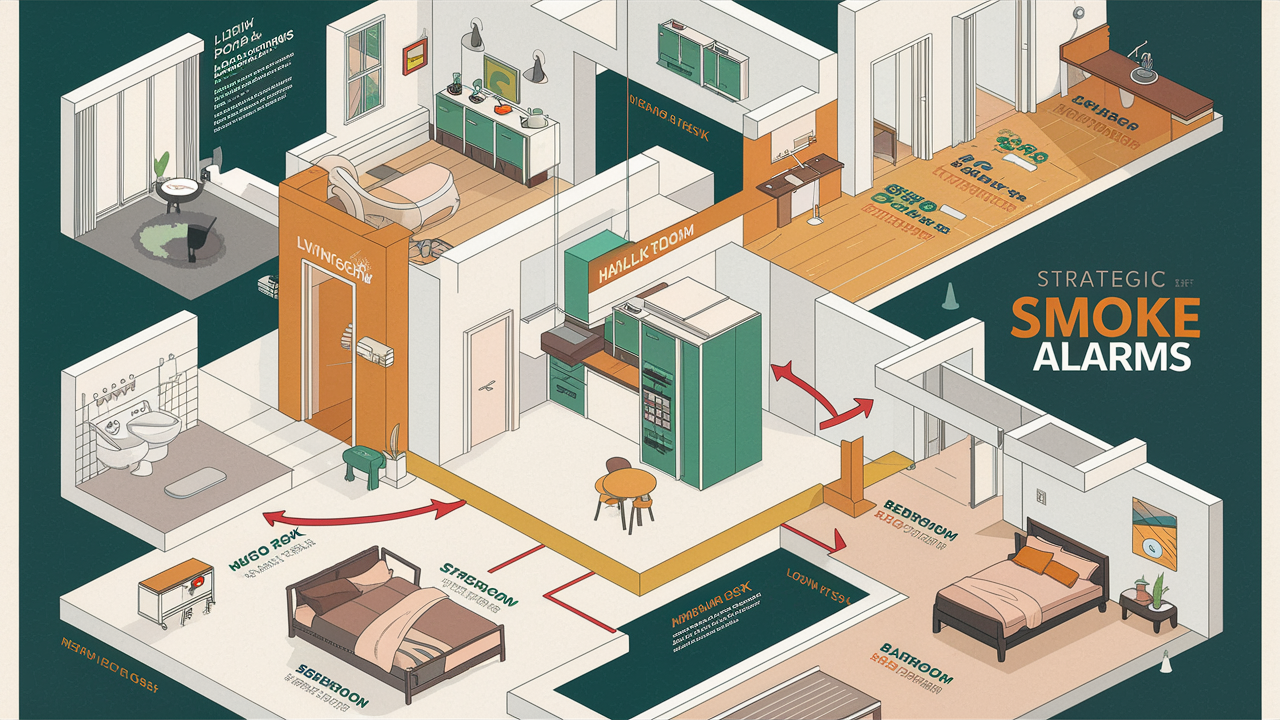
Discover the definitive guide to smoke alarm placement. This article provides essential, actionable advice on where to install smoke alarms in your home to maximize safety and comply with the latest 2025-26 guidelines, ensuring peace of mind for you and your loved ones.
Why Smoke Alarm Placement Matters More Than You Think
The effectiveness of a smoke alarm hinges critically on its placement. A smoke alarm is only as good as its ability to detect smoke quickly and alert occupants before a fire escalates. In 2025-26, fire safety remains a paramount concern, with statistics from the National Fire Protection Association (NFPA) indicating that working smoke alarms significantly reduce the risk of dying in a home fire. Specifically, in reported home fires where the smoke alarm was present but did not operate, one-third of the deaths occurred. In fires where the smoke alarm was present and operated, there were fewer than half the number of fatalities per fire compared to fires with no smoke alarms. This stark contrast underscores the vital role of not just having alarms, but having them correctly placed. Incorrect placement can lead to delayed detection, false alarms, or even render the alarm useless in critical moments. Understanding the science behind smoke detection and airflow within your home is key to optimizing your safety strategy. This guide will delve into the specifics, ensuring your smoke alarms are positioned for maximum life-saving potential.
Understanding Smoke Alarm Types and Their Placement Needs
Before diving into placement, it's crucial to understand the two primary types of smoke detection technology used in residential smoke alarms: ionization and photoelectric. Each type responds differently to the types of smoke produced by various fires, making their placement considerations slightly distinct.
Ionization Alarms
Ionization alarms are generally more responsive to fast-flaming fires, which produce smaller smoke particles. These fires, like those involving paper or grease, tend to burn quickly and spread rapidly. Ionization alarms work by using a small amount of radioactive material to ionize the air in a chamber, creating a current. When smoke particles enter the chamber, they disrupt this current, triggering the alarm. Due to their sensitivity to smaller particles, they are often recommended for placement in areas where fast-flaming fires are more likely, though this is a nuanced recommendation.
Photoelectric Alarms
Photoelectric alarms are more responsive to slow-smoldering fires, which produce larger smoke particles. These fires, like those involving smoldering cigarettes or electrical shorts, can smolder for hours before bursting into flames. Photoelectric alarms use a light beam. In a darkened chamber, the light beam shines across. When smoke enters the chamber, it scatters the light beam onto a sensor, triggering the alarm. These are often recommended for placement in areas where smoldering fires are more probable, such as near living rooms or bedrooms where occupants might be sleeping.
Dual-Sensor Alarms
For comprehensive protection, many experts and fire safety organizations, including the NFPA, recommend using dual-sensor alarms that combine both ionization and photoelectric technologies. These alarms offer the best of both worlds, providing a more robust response to a wider range of fire types. For dual-sensor alarms, the placement guidelines generally follow those for photoelectric alarms, as they are designed to catch both types of smoke effectively.
Hardwired vs. Battery-Operated
The power source of your smoke alarm also plays a role. Hardwired alarms are connected to your home's electrical system and have a battery backup. These are generally considered more reliable as they don't rely solely on batteries, which can be depleted. Battery-operated alarms are simpler to install but require regular battery checks and replacements. Regardless of power source, the placement principles remain the same for optimal detection.
2025-26 Recommendation: Fire safety professionals increasingly advocate for interconnected smoke alarms, whether hardwired or wirelessly linked. When one alarm sounds, they all sound, providing earlier warning throughout the entire home. This technology significantly enhances safety, especially in larger or multi-story residences.
Essential Smoke Alarm Placement Locations: The Core Strategy
The fundamental principle of smoke alarm placement is to ensure they can detect smoke as early as possible and alert everyone in the home. This means strategically positioning them to intercept smoke before it becomes too dense or dissipates too widely. The general consensus from fire safety authorities for 2025-26 centers on several key areas:
- Inside every sleeping area: This is the absolute top priority. Fires often start when people are asleep, and early detection is critical for survival.
- Outside each sleeping area: Placing alarms in the hallway or common area immediately adjacent to bedrooms ensures that smoke traveling from other parts of the house towards the sleeping areas will be detected.
- On every level of the home: This includes basements and finished attics. Fires can start anywhere, and each level needs its own layer of protection.
- In the living room or family room: These are common areas where fires might start due to electrical faults, entertainment equipment, or other hazards.
Beyond these core locations, specific considerations arise for kitchens, garages, and homes with multiple stories. The goal is to create a comprehensive network of detection that covers all potential fire ignition points and all occupied spaces.
Key Placement Rule: Smoke rises. Therefore, alarms should be mounted on the ceiling or high on a wall, at least 4 inches (10 cm) from any wall-and-ceiling corner. This allows smoke to reach the alarm quickly.
Prioritizing Bedroom Safety: Where to Install Alarms for Sleepers
Statistics from the 2025-26 fire incident reports consistently highlight that the majority of fatal home fires occur at night when occupants are asleep. This makes the placement of smoke alarms in and around sleeping areas the single most critical aspect of home fire safety.
Inside Each Sleeping Area
For every bedroom in your home, an alarm should be installed directly inside. This ensures that if a fire starts within a bedroom – perhaps from an electrical appliance, a faulty bedside lamp, or even discarded smoking materials (though smoking in bed is strongly discouraged) – the alarm will sound immediately.
Placement specifics:
- Ceiling Mount: Ideally, mount the alarm in the center of the ceiling. If this isn't possible due to obstructions like light fixtures or ceiling fans, mount it at least 4 inches (10 cm) away from the nearest wall.
- Wall Mount: If mounting on the ceiling is not feasible, place the alarm on the wall, with the top of the alarm no more than 12 inches (30 cm) down from the ceiling.
- Avoid Dead Air Spaces: Be mindful of "dead air spaces" that can occur at the peak of vaulted ceilings or in corners where walls meet the ceiling. Smoke may not reach these areas effectively. For peaked ceilings, install the alarm on the side of the peak within 4 inches (10 cm) of the highest point.
Outside Each Sleeping Area
In addition to alarms inside bedrooms, it is vital to have an alarm located in the hallway or common area immediately outside each sleeping area. This serves two crucial purposes:
- Early Warning for Hallway Fires: If a fire starts in a hallway or common area and spreads towards the bedrooms, this alarm will detect it early.
- Backup Detection: If an alarm inside a bedroom fails to activate for any reason, the alarm outside the bedroom provides a secondary layer of protection.
Placement specifics:
- The hallway alarm should be positioned to cover the path leading to the bedrooms.
- Ensure it is not too far away, so smoke from a hallway fire can reach it quickly.
- For multi-story homes, a smoke alarm should be placed at the top of the stairs leading to the sleeping level.
Example Scenario (2025-26): Consider a family with two children, each in their own bedroom, and parents in a master bedroom. The recommended setup would be:
- One alarm inside Child A's bedroom.
- One alarm inside Child B's bedroom.
- One alarm inside the Master bedroom.
- One alarm in the hallway directly outside these bedrooms.
- If the bedrooms are on an upper floor, one alarm at the top of the stairs leading to that floor.
This layered approach ensures that no matter where a fire starts, the occupants are alerted as quickly as possible, giving them precious time to escape.
Maximizing Coverage in Living Areas and Hallways
Beyond the critical sleeping zones, extending smoke alarm coverage to primary living areas and main hallways is essential for a robust home fire safety system in 2025-26. These areas are often high-traffic zones where fires can originate due to various activities.
Living Room and Family Room Placement
Living rooms, family rooms, and dens are common areas where people gather, relax, and use electronic devices. These spaces present a higher risk of fire ignition from sources such as:
- Faulty wiring in entertainment systems or lamps.
- Overloaded electrical outlets.
- Careless use of candles.
- Children playing with matches or lighters.
- Accidental fires from fireplaces or portable heaters.
Placement guidelines:
- Install an alarm on the ceiling or high on the wall in the main living area.
- If the room is large or has a complex shape, consider installing more than one alarm to ensure adequate coverage.
- Avoid placing alarms too close to kitchens or bathrooms, which can be prone to nuisance alarms (discussed later).
Hallway Placement: The Connectors
Hallways act as conduits for smoke and heat to travel throughout a home. Strategically placed alarms in hallways can provide early warnings of fires originating in adjacent rooms or spreading from one part of the house to another.
Placement guidelines:
- Install an alarm in the center of each long hallway.
- For hallways that are 40 feet (12 meters) or longer, consider installing two alarms spaced evenly apart.
- Ensure that hallway alarms are positioned to effectively monitor the flow of air and smoke.
- Crucially, if a hallway leads to sleeping areas, the alarm in that hallway must be placed to alert those sleeping.
Considerations for Open-Plan Living
In modern homes with open-plan living spaces, defining distinct areas can be challenging. The principle remains the same: ensure coverage for all occupied spaces.
- For large, open-plan areas that combine living, dining, and kitchen functions, place alarms strategically to cover the primary living and dining zones.
- The proximity to the kitchen necessitates careful placement to minimize nuisance alarms, but coverage of the living space must not be compromised.
Example Scenario (2025-26): A family has a large open-plan living/dining area and a separate family room.
- An alarm is placed in the center of the open-plan living/dining area.
- Another alarm is placed in the family room, away from the kitchen area.
- If these rooms are on a different level than the bedrooms, an alarm is placed at the top of the stairs leading to the sleeping level.
This ensures that both primary relaxation areas and the pathways to safety are monitored, providing comprehensive protection against fire threats.
Navigating Kitchens and Appliance Risks: Avoiding Nuisance Alarms
Kitchens are a common source of home fires due to cooking activities. However, they are also notorious for triggering "nuisance alarms" from cooking fumes, steam, or even burnt toast. The key is to place smoke alarms strategically to detect actual fires without being overly sensitive to normal cooking processes.
The Challenge of Kitchen Placement
According to 2025-26 fire statistics, cooking is the leading cause of home fires and home fire injuries. This makes kitchen coverage important, but the presence of heat, steam, and smoke from cooking presents a unique challenge for smoke alarm placement.
Recommended Kitchen Placement Strategy
The general recommendation from fire safety experts is to place smoke alarms at least 10 feet (3 meters) away from cooking appliances. This distance allows smoke from normal cooking activities to dissipate before reaching the alarm.
Specific guidelines:
- Location: If a smoke alarm is necessary in the kitchen area (e.g., in an open-plan home where the kitchen is part of a larger living space), place it on the ceiling or high on the wall, but at a significant distance from the stove, oven, or microwave.
- Avoid Direct Heat/Steam: Never install a smoke alarm directly above or beside a cooking appliance, toaster, or kettle, as these will likely cause false alarms.
- Consider Heat Detectors: In kitchens where nuisance alarms are a persistent problem despite careful placement, consider installing a smoke detector in an adjacent area and a heat detector within the kitchen itself. Heat detectors are designed to respond to rapid temperature increases, not smoke particles, making them ideal for kitchens where smoke is a normal byproduct of cooking.
What Constitutes a Nuisance Alarm?
Nuisance alarms occur when a smoke alarm sounds without a real fire. Common culprits include:
- Steam from showers or cooking.
- Smoke from burnt food or toast.
- Insects entering the alarm chamber.
- Dust or cobwebs accumulating inside the alarm.
- Low battery chirp (which is distinct from a full alarm).
- Alarms nearing the end of their lifespan (typically 10 years).
Minimizing Nuisance Alarms
Even with correct placement, nuisance alarms can happen. Here are tips for minimizing them:
- Ventilation: Ensure good ventilation in the kitchen when cooking. Use range hoods and open windows if safe to do so.
- Fan Use: Turn on exhaust fans before you start cooking.
- Cleanliness: Regularly clean your smoke alarms according to the manufacturer's instructions to remove dust and insects.
- Battery Maintenance: Test alarms monthly and replace batteries at least annually, or when the low-battery chirp sounds.
- Alarm Lifespan: Replace smoke alarms every 10 years, as their sensors degrade over time.
Example Scenario (2025-26): In a home with an open-plan kitchen/living area, the living area has a smoke alarm. The kitchen itself is equipped with a heat detector instead of a smoke alarm, placed on the ceiling directly above the cooking area but not directly over the stove itself, to avoid immediate heat exposure. Smoke alarms are still present in all sleeping areas and hallways. This combination provides comprehensive fire detection while mitigating nuisance alarms from cooking.
Basement and Attic Considerations: Protecting Lower and Upper Levels
Every level of your home presents unique fire risks and requires dedicated smoke alarm coverage. Basements and attics, often overlooked, can be significant fire hazards and need careful consideration for smoke alarm placement in 2025-26.
Basement Safety
Basements can house furnaces, water heaters, laundry appliances, and storage areas, all of which can be potential fire ignition points. Additionally, basements are often the lowest point in a home, meaning smoke and heat may travel upwards, potentially delaying detection on main floors.
Placement guidelines for basements:
- At the Base of the Stairs: Install a smoke alarm at the base of the stairs leading from the basement to the main living area. This is the most critical location, as it will detect fires originating in the basement before they spread upwards.
- Near Sleeping Areas (if applicable): If there is a bedroom or living space within the basement, ensure an alarm is installed inside that area, following the same guidelines as for main-floor bedrooms.
- Near Potential Hazards: Consider placing an alarm near the furnace or water heater if they are in a separate enclosure, but ensure it's not so close that it triggers from normal operational heat or exhaust.
- Avoid Damp Areas: Do not install alarms in excessively damp or humid areas, such as near a washing machine that produces a lot of steam, as this can lead to false alarms.
Attic Safety
Attics, especially finished attics used as living spaces or storage, can also pose fire risks. They may contain electrical wiring, insulation, and stored items that could ignite.
Placement guidelines for attics:
- In Finished Attics: If the attic is finished and used as a living space (e.g., a bedroom, office, or playroom), install a smoke alarm inside that space, following the same rules as for any other bedroom.
- At the Top of the Stairs: If the attic is accessed via stairs, install a smoke alarm at the top of those stairs, on the ceiling or high on the wall. This is crucial for detecting fires that might originate in the attic and spread downwards.
- Consider Storage Areas: If the attic is primarily used for storage, place an alarm on the ceiling in a central location, ensuring it can detect smoke from any potential ignition source.
- Ventilation: Be aware that attics can have poor ventilation. Smoke might linger or dissipate slowly, so ensure the alarm is positioned where it will receive the earliest possible detection.
Important Note: Unfinished attics with only exposed joists and insulation generally do not require a smoke alarm unless they contain significant electrical equipment or are used for storage of highly flammable materials. However, if the attic is the only access to upper floors, an alarm at the top of the access point might be considered.
2025-26 Data Insight: Fires originating in basements or attics can be particularly dangerous because they may go undetected for longer periods, allowing them to grow significantly before alerting occupants. This emphasizes the need for dedicated coverage on these levels.
Multi-Story Homes: Bridging the Gaps Between Floors
Homes with multiple stories present a unique challenge for smoke alarm placement: ensuring that an alarm on one floor can effectively alert occupants on another. The key is to create an interconnected system that bridges the vertical gaps.
The Interconnected Advantage
As mentioned earlier, interconnected smoke alarms are highly recommended for multi-story homes. When one alarm detects smoke, all interconnected alarms throughout the house sound simultaneously. This significantly reduces escape time, especially if a fire starts on a lower floor and occupants are sleeping on an upper floor, or vice-versa.
Strategic Placement Across Levels
For multi-story homes, the following placement strategy is crucial for 2025-26 safety standards:
- Every Level Needs an Alarm: Ensure there is at least one smoke alarm on every level of the home, including the basement and any finished attic.
- Top of Stairs is Paramount: On each floor, install a smoke alarm at the top of the staircase that leads to the next level. This is vital for detecting fires that might be spreading upwards or downwards. For example, on the second floor, an alarm should be at the top of the stairs leading down to the first floor. On the first floor, an alarm should be at the top of the stairs leading down to the basement (if applicable).
- Bottom of Stairs is Crucial: Similarly, install a smoke alarm at the bottom of the staircase leading up from a lower level. This catches fires originating on the lower floor before they ascend.
- Sleeping Area Coverage: Maintain the rule of placing alarms inside and outside every sleeping area on every floor where bedrooms are located.
Example Scenario: A Three-Story Home (2025-26)
Consider a three-story home with bedrooms on the second and third floors, and a finished basement.
- Basement:
- Alarm at the bottom of the stairs leading to the first floor.
- Alarm inside any basement bedroom/living space.
- First Floor:
- Alarm at the top of the stairs leading to the second floor.
- Alarm at the bottom of the stairs leading to the basement.
- Alarm in the main living area.
- Second Floor:
- Alarm at the top of the stairs leading to the third floor.
- Alarm at the bottom of the stairs leading to the first floor.
- Alarm inside each bedroom on the second floor.
- Alarm in the hallway outside the second-floor bedrooms.
- Third Floor:
- Alarm at the bottom of the stairs leading to the second floor.
- Alarm inside each bedroom on the third floor.
- Alarm in the hallway outside the third-floor bedrooms.
If all these alarms are interconnected, a fire starting in the basement will trigger alarms on all three floors, and a fire on the third floor will alert everyone on every level. This layered, interconnected approach is the gold standard for multi-story fire safety.
Special Considerations for Unique Home Layouts and Occupants
While general guidelines provide a solid foundation, every home is unique. Certain architectural features, occupant needs, or specific risks may require additional considerations for smoke alarm placement in 2025-26.
Large or Complex Layouts
For homes with sprawling layouts, multiple wings, or unusually long hallways, a single alarm per area might not be sufficient.
- Multiple Alarms: In large living rooms, great rooms, or long corridors, install more than one alarm to ensure adequate coverage. Space them according to manufacturer recommendations and airflow patterns.
- Dead Air Spaces: Be particularly vigilant about identifying and avoiding dead air spaces, which can occur in rooms with complex ceiling designs, alcoves, or behind large furniture.
Garages and Attached Structures
Attached garages are a common source of concern due to potential fire hazards from vehicles, flammable materials, and electrical equipment.
- Placement: Install a smoke alarm on the ceiling inside the garage. This alarm should be interconnected with the alarms inside the main living area.
- Avoid Extreme Temperatures: Be aware that garages can experience extreme temperature fluctuations. Ensure the smoke alarm is rated for such conditions or placed away from direct exposure to extreme heat or cold.
- Carbon Monoxide: If your garage contains a vehicle, consider a combination smoke and carbon monoxide alarm for enhanced safety, as vehicle exhaust is a primary source of CO.
Mobile Homes and RVs
These dwellings often have limited space and unique construction.
- Compact Design: In smaller spaces, ensure alarms are not placed too close to cooking or heating appliances.
- Battery-Operated: Battery-operated alarms are common and practical. Regular testing and battery replacement are crucial.
- Interconnection: While challenging, consider wireless interconnected alarms if available and feasible.
Occupants with Hearing Impairments
For individuals with hearing impairments, standard audible alarms may not be sufficient.
- Strobe Lights and Vibrators: Specialized alarms with built-in strobe lights and/or connection ports for vibrating pillow shakers are available. These provide visual and tactile alerts in addition to audible ones.
- Placement: Ensure these specialized alarms are placed where the strobe light is visible from all areas of the room and the vibrator can be effectively used.
- Interconnection: Interconnecting these with standard alarms ensures that everyone in the home receives a warning.
Homes with Elderly or Young Occupants
While placement rules are the same, the emphasis on early detection and clear escape routes is heightened. Ensure all alarms are functioning optimally and that escape plans are practiced regularly.
2025-26 Research Highlight: Studies continue to show that homes with interconnected alarms and alarms on every level significantly improve survivability in fire events, particularly for vulnerable populations.
Installation Best Practices and Ongoing Maintenance
Proper installation and consistent maintenance are as critical as correct placement for ensuring your smoke alarms function effectively in 2025-26 and beyond.
Installation Steps
Follow these general steps for installing smoke alarms:
- Read the Manual: Always consult the manufacturer's instructions for your specific smoke alarm model.
- Choose the Location: Select the appropriate location based on the guidelines discussed previously.
- Mounting:
- Ceiling Mount: Use the provided mounting bracket. Secure it firmly to the ceiling using the screws.
- Wall Mount: Use the bracket and screws to attach it to the wall, ensuring it's at the correct height (no more than 12 inches from the ceiling).
- Power Connection:
- Battery-Operated: Insert the battery according to the manufacturer's instructions. Ensure it's seated correctly.
- Hardwired: If you are not comfortable with electrical wiring, hire a qualified electrician to connect the alarm to your home's power supply. Ensure the battery backup is also installed.
- Interconnection (if applicable): Follow the manufacturer's instructions for linking hardwired or wireless alarms. This may involve connecting wires or pairing devices.
- Test the Alarm: After installation, press and hold the test button for several seconds until the alarm sounds. If interconnected, ensure all alarms sound.
Ongoing Maintenance Schedule
Regular maintenance is non-negotiable for reliable smoke alarm performance.
Monthly Testing
Action: Press the test button on each smoke alarm every month.
Why: This verifies that the alarm's power source, circuitry, and horn are working correctly.
Battery Replacement
Action: Replace batteries at least once a year, or immediately when the low-battery chirp sounds. A good reminder is to change them when you change your clocks for daylight saving time.
Why: Dead batteries are a leading cause of smoke alarm failure.
Cleaning
Action: Gently vacuum the smoke alarm cover and vents with a soft brush attachment once every six months. If necessary, wipe the exterior with a damp cloth. Do not use cleaning sprays or solvents.
Why: Dust, cobwebs, and insects can block the sensing chamber and cause false alarms or prevent the alarm from working.
End of Lifespan Replacement
Action: Replace all smoke alarms, regardless of type, every 10 years from the date of manufacture (usually printed on the back of the alarm).
Why: The sensing technology degrades over time, making older alarms less effective and potentially unreliable.
2025-26 Safety Reminder: A smoke alarm that is not maintained is a false sense of security. Make testing and maintenance a family habit.
Conclusion: Securing Your Home with Strategic Smoke Alarm Placement
In the landscape of home safety for 2025-26, the correct placement of smoke alarms stands as a cornerstone of protection against the devastating impact of fire. This comprehensive guide has illuminated the critical areas for installation, from the vital zones within and around sleeping quarters to the essential coverage of living spaces, hallways, basements, and attics. We've explored the nuances of different alarm technologies and addressed the persistent challenge of nuisance alarms in kitchens, emphasizing the importance of strategic positioning and, where appropriate, the use of heat detectors. For multi-story homes, the emphasis on interconnected alarms and bridging vertical gaps has been paramount. Ultimately, effective smoke alarm deployment is not a one-time task but an ongoing commitment. Regular testing, battery replacement, cleaning, and timely replacement of aging units are indispensable. By adhering to these principles of strategic placement and diligent maintenance, you build a robust, life-saving network that provides the earliest possible warning, significantly increasing the chances of escape and survival for everyone in your home. Prioritize these steps today to secure your peace of mind and the safety of your loved ones.