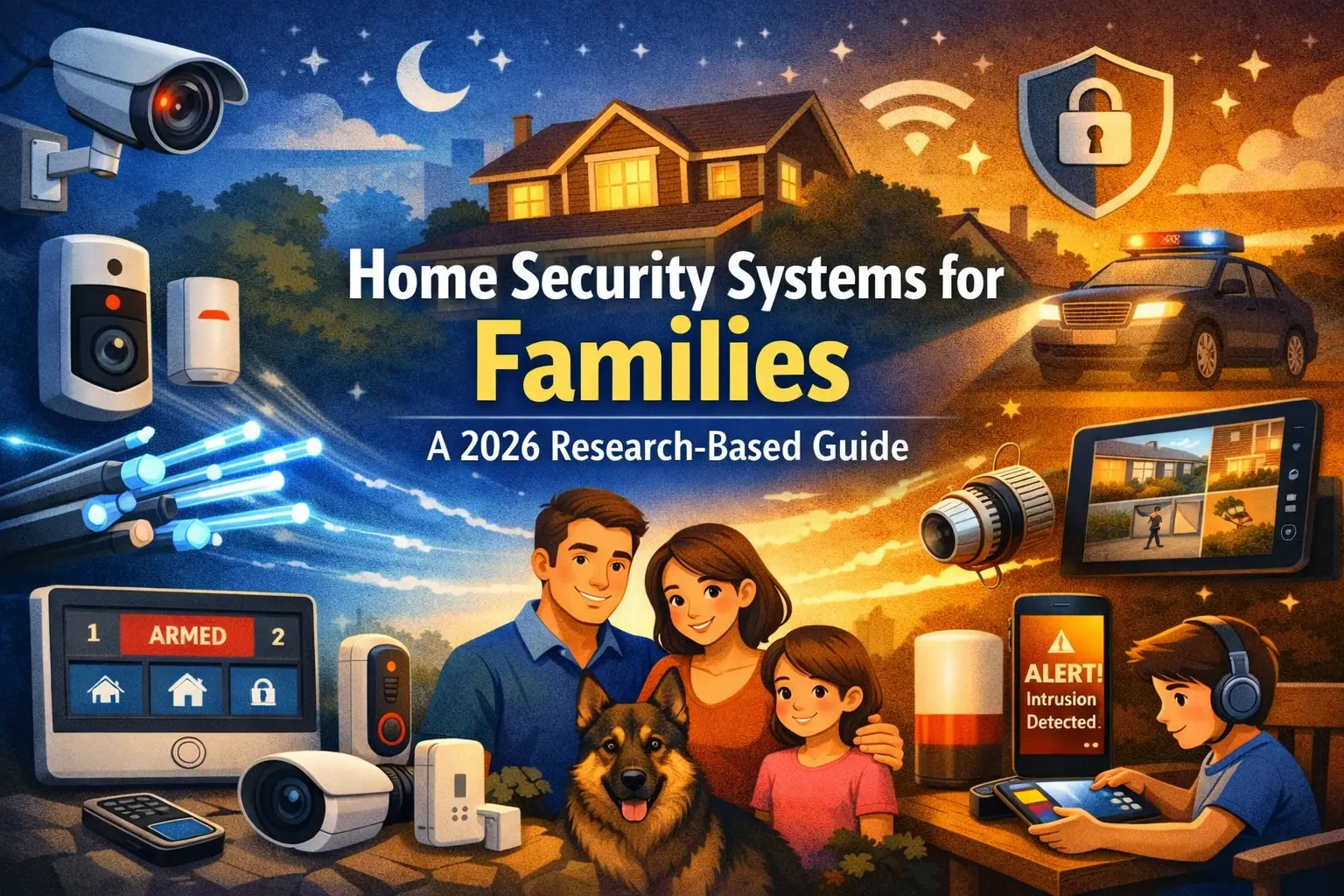
Home Security Systems for Families: A 2026 Research-Based Guide
Choosing a home security system used to mean comparing a handful of alarm packages and picking whichever one a salesperson recommended at the door. That market no longer exists in the same form. By 2026, the home security industry will have grown into a $56.1 billion sector projected to reach roughly $93 billion by 2030, and the product mix families are buying — cameras, smart locks, environmental sensors, app-based monitoring — looks very different from the keypad-and-siren systems of a decade ago.
For families specifically, the calculus is more layered than it is for a single renter or a couple without children. Parents are not only weighing burglary risk; they're also considering a teenager coming home alone after school, a toddler who can reach a side door, a babysitter who needs temporary access, or a smoke detector that wakes the whole house at 2 a.m. This guide walks through what the current research actually shows about residential burglary risk, how families use security technology differently from other households, what systems realistically cost in 2026, and how to evaluate options without falling for marketing claims that outrun the data.
This article is intended as an independent research resource. Where commercial decisions are involved — such as choosing a provider or comparing monitoring plans — readers can find additional comparison tools and consumer resources on Hsforme.com.
Quick Answer
A home security system for families in 2026 typically combines professionally monitored alarm coverage, video doorbells or cameras at entry points, smart locks for keyless access management, and environmental sensors for smoke, carbon monoxide, and water leaks. Most households pay $200–$600 in upfront equipment costs and $20–$40 per month for professional monitoring, which can be partially or fully offset by a 5–20% homeowners insurance discount. Homes without any security system are roughly 300% more likely to be burglarized than homes with one, and 83% of burglars say they check for an alarm system before attempting a break-in. For families with children, the most consequential features are usually app-based door/lock alerts, video coverage of play areas, and monitored smoke/CO detection — not the camera resolution or the brand name.
Key Findings
Metric | Data Point | Source |
|---|---|---|
U.S. burglaries in 2024 | 779,542 incidents (≈1 every 51 seconds) | FBI Crime Data Explorer |
Burglary clearance rate | ~11–13% of cases solved | FBI / Bureau of Justice Statistics |
Homes without a security system | ~46–50% of U.S. households | The Zebra; Michael & Associates |
Burglary risk reduction with visible alarm | Homes without alarms are ~300% more likely to be targeted | Industry burglary research |
Burglars deterred by visible alarm signage | 83% report checking for an alarm before attempting entry | FBI-cited consumer research |
Average burglary loss | ~$2,661–$2,799 per incident | FBI UCR / industry analysis |
U.S. homes with a security camera | 61% (up from 52% in 2024) | SafeHome.org 2026 survey |
Typical insurance discount for monitored systems | 5–20% off annual premium | Insurance Information Institute; multiple insurers |
Why Burglary Risk Still Matters Even as Rates Decline
National burglary numbers have been falling for over a decade, and that trend continued into 2025, with residential burglaries down roughly 19% in the first half of the year compared to the same period in 2024. It would be easy to read that as a signal that home security is becoming less necessary. The research doesn't support that conclusion.
Three things remain true at the same time: rates are declining, burglary is still extremely common, and the consequences of being a victim haven't gotten any lighter. With clearance rates hovering around 11–13%, the overwhelming majority of burglary cases are never solved, which means recovery of stolen property is the exception rather than the rule — only about 29% of stolen property is ever recovered. For a family, that turns a break-in from an inconvenience into a financial and emotional event that insurance and police involvement only partially resolve.
There's also a seasonal and behavioral pattern families should understand. Summer months — particularly July — see elevated burglary rates, correlating with vacation travel and homes left empty for longer stretches. And contrary to the popular image of a nighttime intruder, burglars actually favor daytime hours, when homes are statistically more likely to be unoccupied because of work and school schedules. For a working family, that means the riskiest window often isn't bedtime — it's the middle of a weekday.
What Burglars Actually Look For
Burglary research consistently points to opportunity, not sophistication, as the dominant factor. Roughly 85% of home break-ins are committed by non-professionals exploiting an easy target rather than executing a planned operation. The decision-making process burglars describe in studies is fairly mechanical: they're scanning for visible cameras or alarm signage, checking whether anyone seems to be home, and looking for the path of least resistance — an unlocked door, a low window, an overgrown yard that provides cover.
This is precisely why visible deterrents matter as much as the underlying technology. A camera that nobody can see from the street provides excellent evidence after a break-in but does little to prevent one. Visible security cameras are associated with a 35% decrease in burglary attempts, and the front door remains the single most common entry point, used in roughly a third of break-ins, followed by back doors and ground-floor windows.
Where Family Households Diverge From the General Population
The most useful data point for this guide doesn't come from general burglary statistics — it comes from a 2026 SafeHome.org survey comparing security habits between households with and without children. Parents build noticeably more comprehensive security setups than non-parent households, with the largest gaps showing up in video doorbells, outdoor cameras, and smart locks — devices that monitor who is coming and going. That pattern reflects something fairly intuitive: for families, security isn't only about preventing theft. It's about tracking who enters the home, when kids arrive after school, and whether a side gate was left open during outdoor play.
This is also where AI-based detection has moved from a premium feature to something close to standard. Person and package detection — AI distinguishing a human from a passing car or a pet — has reached roughly 28% adoption, largely because Ring, Nest, and Eufy now ship it as a default rather than an add-on. For a family, that detail matters less for catching intruders and more for cutting down the false-alarm fatigue that causes people to stop arming their systems altogether, a failure mode multiple security researchers flag as one of the more common reasons monitored systems get abandoned within the first year.
The Layered-System Approach Families Actually Use
Security researchers increasingly describe family home security less as a single product and more as a layered system: entry-point monitoring, child-safety features, and remote awareness when parents are out of the house. In practice, that tends to break down into four categories.
Entry monitoring covers door and window sensors, video doorbells, and smart locks. For families with school-age children, smart locks in particular solve a recurring logistical problem — issuing a temporary code to a babysitter or grandparent without handing over a physical key, and getting an automatic notification when a child arrives home and unlocks the door.
Environmental monitoring covers smoke, carbon monoxide, and water-leak sensors connected to the same app as the security system. This is a category families frequently underweight relative to burglary protection, even though having a working smoke alarm reduces fire-related death risk by at least 30%, a figure that climbs to roughly 71% in homes with hardwired, battery-backed detectors. Unlike a standalone smoke detector, a monitored one can alert a parent at work the moment it triggers, not just the people inside the house.
Outdoor and play-area coverage extends past the front door. Backyards, driveways, and side yards are where children spend unsupervised time, and they're also the areas most commonly missed in a security setup that was designed around the front entrance.
Access and routine management are the layer most specific to families with kids old enough to come and go independently — geofencing that auto-arms the system when everyone leaves, app-based door logs, and simplified controls that a babysitter or teenager can actually use without a tutorial. One pattern repair technicians and reviewers note often: a system too complicated for every family member to operate confidently tends to get disarmed and ignored, which defeats the purpose regardless of how advanced the hardware is.
What Families Actually Pay in 2026
Cost is frequently the deciding factor, and the range is wide enough that "average cost" figures can be misleading without context.
Cost Component | Typical 2026 Range |
|---|---|
Equipment (starter kit) | $200–$600 |
Equipment (comprehensive system) | $600–$1,500+ |
Professional installation | $0 (DIY) – $199 |
Self-monitoring | $0–$10/month |
Professional monitoring | $20–$60/month (most plans cluster at $20–$35) |
DIY installation has overtaken professional installation for the first time as of the 2026 SafeHome.org survey, with 49% of alarm system users self-installing compared to 42% who hired a professional — a shift driven largely by peel-and-stick sensors and app-guided setup that didn't exist in earlier wired systems.
The figure families most often miss is the insurance offset. Most major insurers offer a 5–20% discount on homeowners' premiums for a professionally monitored system, generally requiring a monitoring certificate from the provider confirming the system reports to a UL-listed central station. On the national average homeowners' premium of roughly $1,400–$1,800 per year, a 10–15% discount works out to $140–$270 in annual savings — enough to offset most or all of a basic monitoring plan. Self-monitored systems without a central monitoring station typically qualify for a smaller protective-device credit rather than the full discount tier, which is worth confirming with an insurer before assuming a free or low-cost plan will produce the same savings as a monitored one.
Research Insights
The data points in this article tell a consistent story when read together, and the implications for families are more specific than the general "get a security system" advice common in consumer content.
First, the gap between perceived and actual risk reduction is mostly about visibility, not sophistication. The 35% drop in burglary attempts associated with visible cameras and the 83% of burglars who report checking for an alarm before attempting entry both point to the same mechanism: deterrence happens before a break-in is attempted, which means a hidden, high-end camera system can underperform a cheaper one with visible signage and an obvious doorbell camera at the front door. Families optimizing purely for camera resolution or AI sophistication may be solving the wrong problem — evidence quality matters after an incident, but visibility is what prevents one in the first place.
Second, the SafeHome.org finding that parents disproportionately adopt video doorbells, outdoor cameras, and smart locks — rather than indoor cameras or alarm panels — suggests that for families, the primary anxiety being addressed isn't intrusion in the abstract. It's awareness of movement at the perimeter: who's at the door, whether a child has come home, whether a side gate was left open. That's a meaningfully different design priority than the "stop a burglar" framing most security marketing leads with, and it explains why entry-point and perimeter devices show the largest adoption gap between parent and non-parent households rather than interior motion sensors or panic buttons.
Third, the rise of edge AI processing — cameras that distinguish people from pets or vehicles locally, without sending every clip to the cloud — is solving a problem that was previously a major source of system abandonment: false-alarm fatigue. A system that triggers for every passing car or the family dog gets disarmed within weeks. The shift toward on-device AI filtering, now standard in a meaningful share of new camera installs, is less a luxury upgrade than a fix for the reliability gap that caused earlier-generation systems to fail in practice even when the hardware itself worked correctly.
Fourth, the insurance discount mechanism is underused relative to how reliably it pays out. Because the discount requires documentation, most homeowners don't think to request — a monitoring certificate — a meaningful share of insured households with monitored systems are likely leaving a 5–20% discount unclaimed simply because nobody asked their provider for the paperwork.
Consumer Impact
For a typical family, these findings translate into a few practical conclusions. A system doesn't need to be the most expensive option to meaningfully reduce risk — visible deterrence and reliable entry-point monitoring do most of the work that burglary prevention research credits to security systems generally. Environmental monitoring (smoke, CO, water leak) deserves equal weight to intrusion detection, particularly because it's the category most likely to be skipped when budgets get tight, despite carrying some of the clearest life-safety data of any feature in this guide.
Families with children old enough to come home independently should weigh smart locks and door-activity alerts highly, since the data suggests this is where parent households diverge most sharply from the general population in actual usage. And before finalizing a provider, requesting a monitoring certificate and confirming the applicable insurance discount with a homeowners or renters insurer is a five-minute step that, per the data above, can offset a meaningful share of the ongoing monitoring cost.
Families comparing providers and monitoring plans side by side can use independent comparison resources on Hsforme.com, and for households with specific questions about local provider availability, calling (888) 805-5456 connects with someone who can walk through options based on home size and budget.
Frequently Asked Questions
Are home security systems actually worth it for families with young children?
Yes, based on the available data. Beyond burglary deterrence, monitored systems extend basic life-safety functions — smoke and CO alerts that reach a parent's phone even when no one is home, and door sensors that confirm when a child has arrived safely. Homes without any system are roughly 300% more likely to be targeted by burglars, and the layered protection (entry, environmental, and access monitoring together) addresses risks beyond theft alone.
What's the single most important feature for a family with school-age children?
Smart locks paired with app-based entry alerts tend to address the most common family-specific use case: knowing when a child has gotten home, granting temporary access to a babysitter without a physical key, and avoiding lockouts. Video doorbells are a close second, since they let a parent verify a visitor's identity remotely.
Does a home security system really lower homeowners' insurance premiums?
In most cases, yes, though the amount depends on the insurer and system type. Professionally monitored systems connected to a UL-listed central station typically qualify for a 5–20% discount on the annual premium, while self-monitored systems without professional dispatch often receive a smaller protective-device credit. Homeowners need to request a monitoring certificate from their provider and submit it to their insurance agent to activate the discount.
How much does a basic family security system cost per month after accounting for insurance savings?
A typical setup runs $20–$35 per month for professional monitoring after a $200–$600 upfront equipment cost. With a 10–15% insurance discount on an average premium, many households offset $140–$270 of that annual cost, bringing the effective net monthly cost down to roughly $10–$20 in many cases, depending on the specific policy and provider.
Do visible cameras actually deter burglars, or is that overstated?
The deterrent effect is well documented. Visible security cameras are linked to a 35% reduction in burglary attempts, and a large share of burglars — around 83% in commonly cited research — report checking for visible alarm or camera signage before attempting a break-in. Hidden cameras still provide valuable evidence after an incident, but visible placement does more to prevent one from happening.
What time of day are burglaries most likely to happen?
Despite the common assumption that break-ins happen at night, daytime burglaries are slightly more common, particularly between late morning and mid-afternoon when homes are statistically more likely to be empty due to work and school schedules. Families should consider this when evaluating which hours of the day their home security coverage matters most.
Is DIY installation reliable enough for a family, or should we hire a professional?
DIY installation has become the more common choice — 49% of alarm system users self-installed as of 2026, slightly ahead of professional installation. Modern peel-and-stick sensors and app-guided setup have made this practical for most households. Families with larger homes, more complex wiring needs, or limited comfort with troubleshooting smart home tech may still prefer professional installation for reliability.
How do we avoid false alarms that make the whole family stop using the system?
False-alarm fatigue is one of the most common reasons security systems get abandoned. Systems with on-device (edge) AI that can distinguish people, pets, and vehicles substantially reduce false triggers compared to older motion-only sensors. Choosing a system with this capability and taking time to properly calibrate sensor sensitivity during setup meaningfully reduces the odds that the system gets disarmed and forgotten.