Best Home Security Systems for Seniors in 2026: A Research-Backed Guide
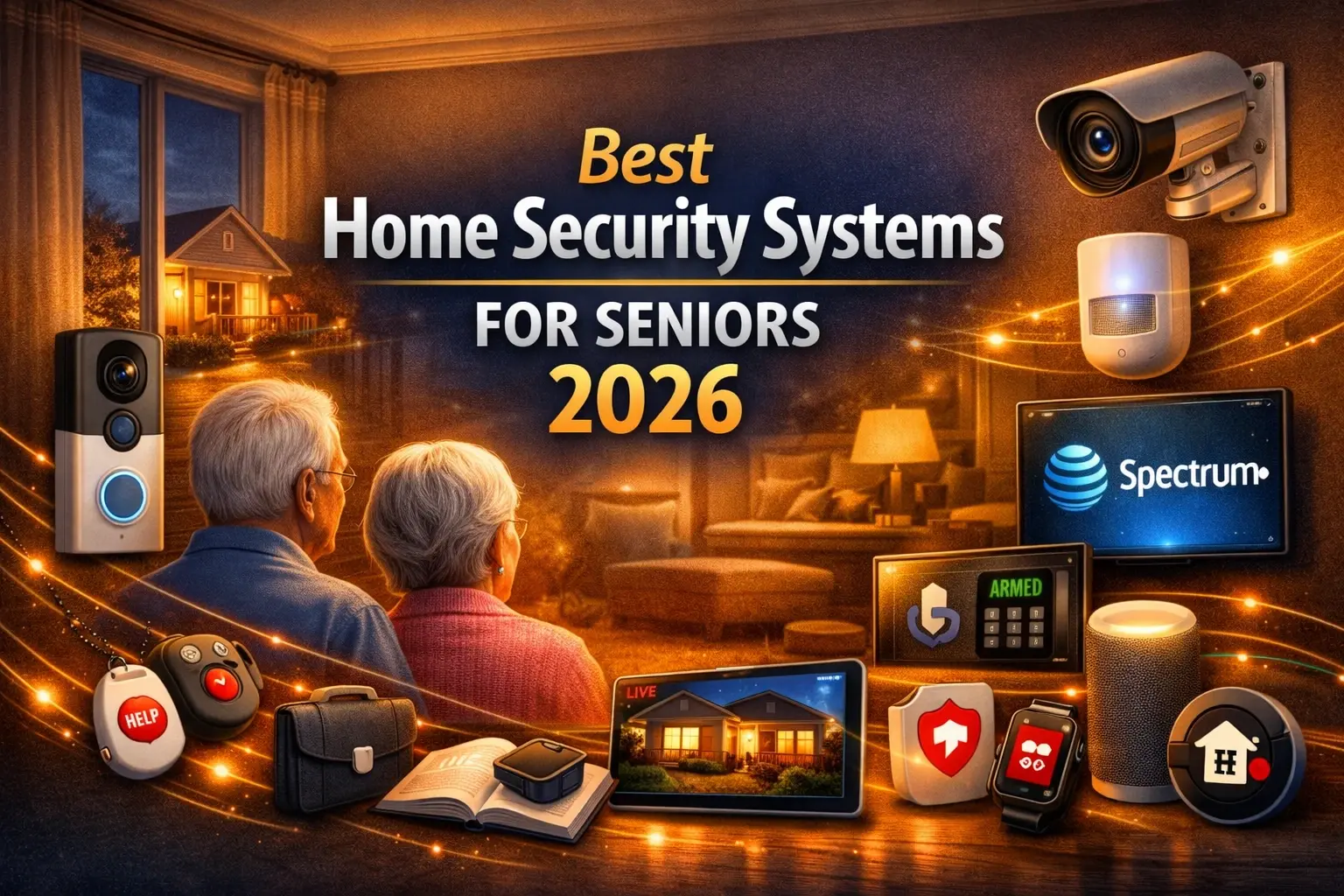
The overwhelming majority of older Americans want to stay in their own homes as they age. National surveys consistently put that figure near 90 percent, and Census data backs it up: roughly 88 percent of adults 65 and older lived in their own home in recent years, with only a small share in nursing facilities or group settings. That preference has a name — aging in place — and it has quietly reshaped an entire segment of the home security industry.
But aging in place changes the calculus of home safety. A security system built for a busy household with young kids is not automatically the right fit for a 78-year-old living alone. Keypad complexity, siren volume, monitoring response time, and how quickly a family member gets notified all matter more when the person using the system may have limited vision, hearing loss, arthritis, or memory changes. This guide reviews independent research and current industry data on home security for seniors, which features actually matter, and how to evaluate options responsibly.
Quick Answer
For most older adults, a professionally monitored system with 24/7 live monitoring, simple voice or app-based controls, and cellular backup offers the best combination of protection and ease of use. Industry testing organizations, including Security.org and SafeHome.org, have repeatedly ranked ADT, SimpliSafe, and Vivint among the top choices for seniors in 2026, largely because of their senior-friendly controls, professional installation options, and reliable monitoring networks. Systems in this category typically run $200 to $600 in upfront equipment costs and $20 to $60 per month for monitoring, though DIY alternatives can lower both figures considerably.
Key Findings
Independent testing consistently favors professionally monitored systems for seniors. Reviewers evaluating dozens of systems have ranked ADT as the top pick for seniors due to its simple controls, professional monitoring, and an AARP member discount of up to 20 percent, with SimpliSafe and Vivint also rated highly for their environmental sensors and active deterrence features.
Loud, audible alerts matter more with age. Because hearing loss becomes more common as people age, testers weigh siren volume heavily, noting SimpliSafe reaches 95 decibels with an optional 105 dB add-on. At the same time, ADT offers an adjustable 85 to 95 dB range.
Voice control reduces physical barriers. For users managing arthritis, vision issues, or mobility challenges, voice control removes the need to interact with a keypad or screen, and reviewers found the top three senior-recommended systems all integrate with Alexa and Google Home.
Financial exploitation now outpaces burglary as a threat to seniors. According to the FBI's Internet Crime Complaint Center, adults 60 and older filed more than 201,000 complaints in 2025 and reported $7.748 billion in losses, up 59 percent from the prior year, and the average loss per senior victim reached $38,500, with more than 12,400 older complainants losing over $100,000 each.
Home security and medical alert systems solve different problems. Research summaries note that a home security system protects the home and property, while a medical alert device is designed to protect the wearer during a fall or medical emergency — a distinction many families overlook when shopping for a single solution.
Main Analysis
Why Seniors Have Different Security Needs
Roughly 28 percent of adults 65 and older lived alone as of 2023, and that share rises sharply with age — approximately 42 percent of women 75 and older live alone. Living alone changes the risk profile in two ways: there's no one else in the home to notice an intrusion or a medical event, and there's no second set of eyes to catch a scam in progress before money changes hands.
At the same time, seniors are frequently targeted by criminal actors because they are often perceived as more polite and trusting, assumed to be more financially stable, more likely to own real estate, and more likely to spend time alone — all of which lowers the perceived risk to a criminal and raises the payoff. That combination of factors is why security researchers now treat "protecting seniors" as a distinct product category rather than a checkbox feature.
What Independent Testing Organizations Found
Consumer research groups that test home security equipment firsthand — rather than simply comparing spec sheets — have converged on a similar shortlist for 2026. Reviewers at Security.org, who researched and tested over 60 popular home security systems before narrowing the field to three finalists for seniors, built their evaluation criteria specifically around aging-related needs: keypad simplicity, monitoring reliability, and whether a company offers a senior discount.
SafeHome.org used a comparable weighting system, evaluating ease of use at 40 percent of the total score, ease of installation at 30 percent, and monitoring performance at 30 percent, reasoning that technology can be intimidating for aging adults, so arming a system should be as simple as switching on a television. Under that framework, testers found ADT the most reliable option, with its network of monitoring centers that specialize in both home security and medical emergencies</cite>, while also crediting SimpliSafe, Vivint, Cove, and Frontpoint with unique features suited to seniors</cite>.
Cost remains a major factor in these evaluations. Recent testing found ADT's professional monitoring runs $24.99 to $39.99 a month, with equipment costs ranging from $199 for a basic setup to $1,600 for more comprehensive protection, and professionally installed packages typically costing $499 to $1,049. Broader industry data puts entry-level pricing even lower: a new home security system generally costs between $49 and $499 upfront, with monthly professional monitoring ranging from $4.99 to $39.99.
DIY vs. Professional Installation
Professional installation removes a common barrier for older adults who may not want to drill sensors into door frames or configure a cellular hub themselves. But it isn't the only path. DIY systems have improved significantly, and cost-conscious households have real alternatives: choosing a no-contract DIY system such as SimpliSafe lets a household walk away from professional monitoring at any time without penalty, and self-monitoring instead of paying for professional monitoring can save $20 to $50 per month.
The tradeoff is response time and reliability. A self-monitored system depends on the resident (or a caregiver) actually seeing and acting on a phone alert. Researchers note that when a break-in or fire is detected, a self-monitored system alerts the resident by phone or app, and it is then up to that person to contact emergency services — a workable model for a tech-comfortable senior with family nearby, but a risk for someone who doesn't reliably carry or check a smartphone.
The Features That Actually Move the Needle for Older Adults
Not every "smart home" feature matters equally once age-related needs are factored in. Based on hands-on testing, four categories consistently separate senior-friendly systems from the rest:
Loud, adjustable sirens. As noted above, testers specifically call out decibel ranges because hearing loss is a more prevalent issue as people age.
Cellular backup with no landline requirement. All the top-rated systems for seniors now use cellular backup to keep protection active even if home internet service goes down.
Group text and family circle alerts. One widely used feature sends a group text to every member of a family circle when a sensor triggers, so any relative can take action, which is particularly useful when an adult child lives near an aging parent and wants real-time notifications.
Pre-configured, minimal-setup equipment. Systems built for fast setup — for example, equipment that arrives pre-programmed out of the box — reduce the friction that keeps some seniors from using a system correctly, or at all.
Home Security Systems Are Not Medical Alert Systems
This distinction deserves its own section because it's the single most common point of confusion for families researching senior safety. A home security system protects the property from intrusion, fire, and environmental hazards. A medical alert system — often a pendant or wristband with a call button — protects the individual during a fall or health emergency. Guidance from senior research organizations is direct on this point: a home security system may be the better fit for someone concerned about neighborhood crime, frequent travel, or fire and flooding risk, while a medical alert system is ideal for someone with a history of falling, a serious medical condition, or who lives alone. Many households ultimately need both, and a number of the same providers that sell home security also offer medical alert or personal emergency response devices, some with fall detection and GPS location built in.
Research Insights
Two trends stand out from this research that go beyond the standard "which system is best" comparison.
First, the threat profile for seniors has shifted from physical to financial. Property crime against older Americans has not disappeared, but the dollar figures show scam losses now dwarf burglary losses by an enormous margin. With people age 50 and older reporting $4.3 billion lost to fraud in 2025 alone, compared with $2.3 billion for all younger adults combined, it's worth noting that a growing share of security-focused product design for seniors — video doorbells that screen visitors, two-way audio to verify who's actually at the door, caller-ID-aware smart locks — is really fraud-adjacent home security, not just burglary prevention. A system that lets a senior see and speak to whoever is at the door before opening it addresses both an intruder and an in-person scam artist (a category the FBI specifically tracks under "home repair scams" and impersonation schemes).
Second, the industry's own testing methodology reveals an underlying assumption worth questioning: ease-of-use scoring is typically weighted highest (40 percent in at least one major testing framework), which means the "best" system for a senior is frequently not the most feature-rich one, but the one most likely to actually get used correctly every day. A sophisticated system that gets left disarmed because the resident found it confusing provides zero protection. That's a meaningful finding for any family evaluating options: prioritize a system a parent or grandparent will use without help over one that scores highest on paper.
Consumer Impact
For a senior living alone, the practical impact of these findings is straightforward:
A loud, professionally monitored system reduces reliance on the resident to notice a triggered sensor themselves.
Voice control and simplified apps lower the chance that arthritis, vision changes, or unfamiliarity with technology leads to a system going unused.
Family notification features give adult children real-time visibility without requiring the senior to make a phone call during a stressful moment.
Because financial fraud losses among seniors now exceed $7 billion annually, video verification and two-way audio at the front door offer protection against a threat category that traditional burglar alarms were never designed to address.
Families and caregivers evaluating options can also review general research and provider comparisons available at hsforme.com, which covers home security topics relevant to households at every stage of life.
Future Outlook
Industry testers are already tracking where senior-focused security is headed next. Expect continued convergence between home security and medical alert categories, as more top providers bundle personal emergency response devices with fall detection directly into their home security packages rather than selling them as separate products. AI-assisted monitoring is also becoming more relevant on the fraud-prevention side: as the FBI has documented, voice-cloning technology is now being used in "grandparent" and distress scams to mimic a family member in crisis, and some monitoring companies are beginning to explore verification tools that could eventually integrate with home security platforms to flag suspicious callers or visitors. As the population 65 and older continues to grow toward a projected 82 million by 2050, demand for systems that are both simple to operate and comprehensive in scope is likely to keep expanding.
Frequently Asked Questions
What is the best home security system for an elderly parent living alone?
Independent testers most often recommend professionally monitored systems with simple controls, such as ADT, SimpliSafe, or Vivint, because they combine 24/7 monitoring with voice control and minimal setup. The right choice ultimately depends on budget, whether professional installation is preferred, and whether the household also needs medical alert or fall-detection features.
Do home security companies offer senior discounts?
Some do. Certain providers offer AARP member discounts of up to 20 percent, though promotional new-customer offers — free equipment, discounted installation, or reduced first-month fees — are often more valuable than a standing senior discount, so it's worth comparing both.
Is a home security system or a medical alert system better for seniors?
They serve different purposes and aren't interchangeable. A home security system protects against intrusion, fire, and environmental hazards, while a medical alert system is designed specifically to summon help during a fall or health emergency. Many households benefit from having both.
How much does a home security system cost for seniors?
Entry-level equipment can start around $49 to $199, with more comprehensive professionally installed systems running $500 to $1,600. Monthly professional monitoring typically ranges from about $5 to $40, while self-monitored or DIY systems can eliminate the monthly fee.
Can a senior operate a home security system without a smartphone?
Yes, though it limits some conveniences. Systems with physical keypads, voice control through Alexa or Google Home, and professional monitoring don't require the resident to use a smartphone app, though self-monitored systems generally do require a phone to receive and act on alerts.
What features matter most for a senior using a home security system?
Testing organizations point to four consistently: adjustable, loud sirens for those with hearing loss; voice control for those with mobility or vision limitations; cellular backup so the system stays active during an internet or power outage; and family-circle text alerts so relatives are notified in real time.
Are seniors more likely to be victims of financial fraud than burglary?
Current data suggests yes, by a wide margin. Adults 60 and older reported nearly $7.75 billion in fraud losses in 2025 alone, a figure that dwarfs typical burglary-related losses and reflects a shift toward scams — including tech support fraud, romance scams, and impersonation schemes — as the primary financial threat to this age group.
Conclusion
The research is consistent across multiple independent testing organizations: for most seniors, the "best" home security system isn't necessarily the most advanced one, but the one that pairs reliable professional monitoring with genuinely simple day-to-day operation. Loud sirens, voice control, cellular backup, and family notification features aren't luxury add-ons for older users — they're the difference between a system that gets used correctly every day and one that quietly goes unarmed. At the same time, the data makes clear that physical security is only part of the picture; with senior fraud losses now measured in the billions, households evaluating home security should think about video verification and caller screening as fraud-prevention tools, not just burglary deterrents. Readers comparing providers and pricing can find additional research and current guides at hsforme.com, or call (888) 805-5456 to discuss options for a specific household's needs.